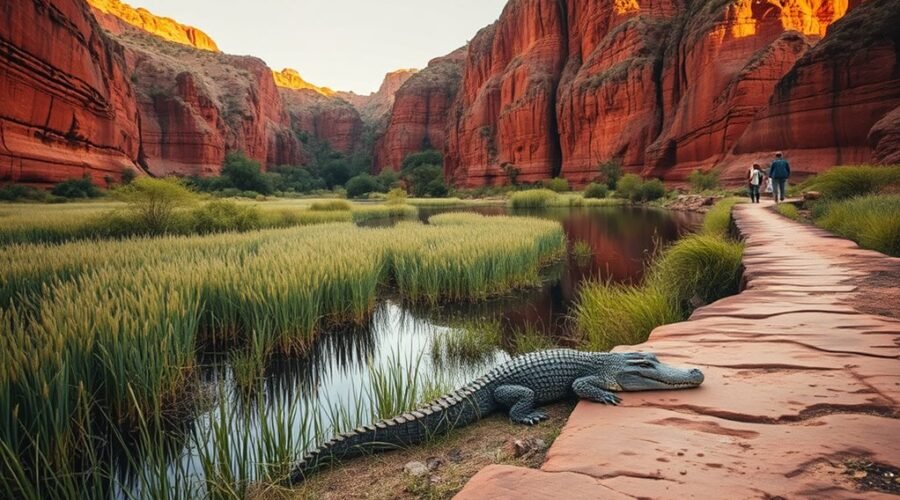
Picture an early morning at Kakadu’s Yellow Water: mist above the wetlands, birds moving across the floodplain, and the day still cool enough to linger. The best time to visit the Northern Territory depends on where you are going. The tropical Top End and the semi-arid Red Centre have very different climates, so the ideal month for Darwin or Kakadu is not always the ideal month for Uluṟu or Kings Canyon.
Quick Answer
For a trip covering both the Top End and Red Centre, May and September are two of the strongest compromise months. The Top End is driest from May to October, while the Red Centre is generally most comfortable from April to October. June–August brings cooler weather but higher demand, while November–April favors storms and waterfalls in the north but requires more flexible plans.
Key Takeaways
- Top End: May–October is the dry season, with lower humidity, little rain and the most reliable access to many parks and outdoor attractions.
- Red Centre: April–October usually provides the most comfortable conditions for sightseeing and longer walks, although winter nights can be very cold.
- Best cross-Territory compromise: May or September gives you dry-season conditions in the north and generally comfortable temperatures in Central Australia.
- Wet-season travel: November–April can bring dramatic storms, lush landscapes and waterfalls in the Top End, but roads and attractions can close with little notice.
- Do not assume a 4WD makes a route safe: obey closures, never enter floodwater and check official road and park reports before remote travel.
Quick Guide: Best Months to Visit the Northern Territory (By Priority)
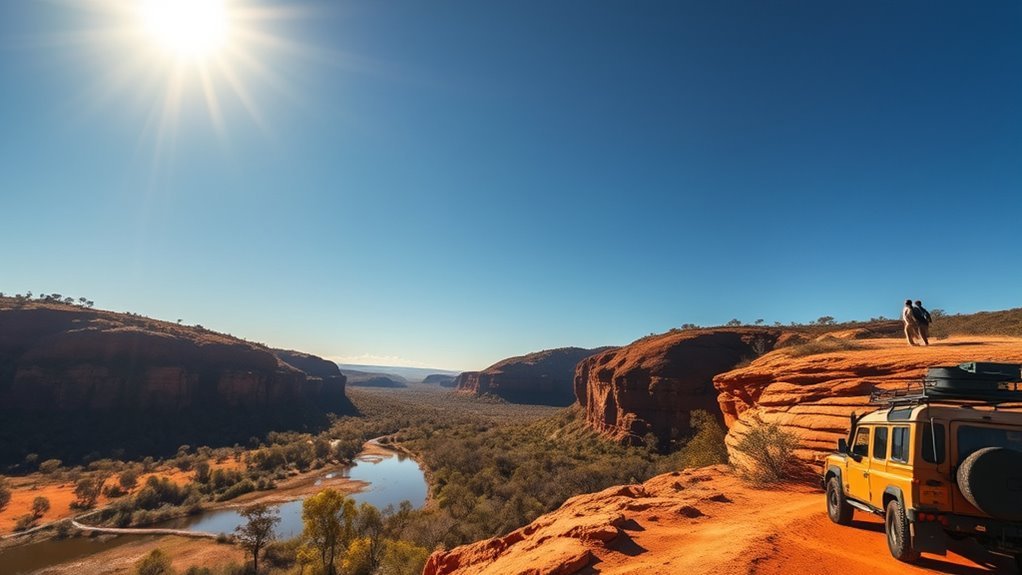
The Northern Territory stretches across two major climate zones. According to Tourism NT’s weather and seasons guidance, the Top End has a tropical wet/dry cycle, while the Red Centre experiences four more conventional seasons.
| Priority | Best Period | Why It Works | Main Trade-off |
|---|---|---|---|
| Top End weather & access | May–October | Lower humidity, little rain and wider park access | June–August is busy and accommodation can sell out |
| Red Centre hiking | April–September | Cooler daytime conditions for longer walks | Winter mornings and nights can be near or below freezing |
| Both regions in one trip | May or September | Good overlap between Top End access and Red Centre comfort | September becomes hotter in both regions |
| Waterfalls & dramatic storms | December–March | Top End landscapes are lush and waterfalls can be spectacular | Heat, humidity, storms and seasonal closures |
| Lower crowds | Top End tropical summer; Red Centre shoulder periods | Potentially quieter tours and accommodation | Weather or heat may restrict what you can do |
If you mainly want reliable Top End sightseeing, choose May–October. If Uluṟu, Kata Tjuṯa, Alice Springs and Kings Canyon are your priority, April–September is especially comfortable for outdoor activity. October can still work in the Red Centre, but afternoons become much hotter.
For stargazing, do not rely on a single “best” month. Clear skies, cloud cover, moon phase and your distance from artificial light matter more. A moonless night at a remote Red Centre location can be excellent during much of the cooler half of the year.
Best Time to Visit the Top End (Kakadu & Darwin): Weather & Crowds
The Top End includes Darwin, Kakadu, Katherine and Arnhem Land. Its dry season runs from May to October, while the tropical wet season runs from roughly November to April.
During the dry season, typical Top End conditions are around 21–32°C, with far lower humidity and very little rain compared with the wet season. It is still warm during the day, but mornings and evenings feel much more comfortable.
Dry Season Advantages
May–October offers the broadest range of outdoor options in the Top End. Roads and walking tracks that were affected by wet-season flooding progressively reopen, humidity falls and camping becomes more comfortable.
It is also the busiest time of year. Darwin’s event calendar becomes active, popular Kakadu and Litchfield sites attract more visitors, and tours, rental vehicles and accommodation can book out around major events and school-holiday periods.
May and early June can provide a useful balance of dry weather and slightly lower demand. July and August bring classic dry-season conditions but are among the busiest periods. September remains dry in most years but becomes warmer as the build-up approaches.
Mosquito pressure generally falls compared with the wet season, but mosquitoes do not disappear. Repellent is still sensible, particularly around wetlands and near dusk.
Wet Season Considerations
From November to April, the Top End becomes hotter and much more humid. Thunderstorms, monsoonal rain and flooding can transform floodplains and waterfalls, producing some of the Territory’s most dramatic scenery.
This season can also limit ground access. A road that was open earlier in the trip may close after heavy rain, and some waterfalls are easier to experience from a scenic flight or approved cruise than by road.
You do not automatically need a high-clearance vehicle simply because it is the wet season. Darwin, Kakadu, Katherine and many other major destinations are linked by sealed roads. Use a 4WD only where the open route, rental agreement and local conditions require one.
Warning: Never drive through a closed road or floodwater, even in a 4WD. In the Top End, also assume waterways may contain crocodiles. Only swim where current signs specifically identify the location as open and managed for swimming.
Best Time to Visit the Red Centre (Uluṟu & Kings Canyon): Weather & Access
The Red Centre follows a different calendar from Darwin and Kakadu. Tourism NT lists average seasonal ranges of about 12–27°C in autumn, 3–20°C in winter, 13–31°C in spring and 20–35°C in summer.
For Uluṟu, Kata Tjuṯa, Alice Springs and Kings Canyon, April through September is an especially strong period for walking and sightseeing. April–May brings warm days and cooler evenings. June–August offers the coolest daytime conditions, although desert nights can fall below freezing. September is warmer without normally reaching the sustained summer heat.
October can still be enjoyable if you schedule walks early, but average daytime temperatures are rising quickly by then. December–February can be very hot, making long exposed walks far more demanding.
Heat rules are important. At Watarrka National Park, when the forecast reaches 36°C or above, visitors must begin the Kings Canyon Rim Walk before 9am. Uluṟu-Kata Tjuṯa National Park also applies heat-related restrictions to walks such as Valley of the Winds.
Roads to the major Red Centre destinations are generally reliable, but heavy rain can still create temporary closures or damage. Do not describe any remote road as guaranteed to be open simply because you are travelling in a traditionally dry month.
Pro Tip: If you want to combine Darwin/Kakadu with Uluṟu/Kings Canyon in one trip, look first at May or September. Both months sit inside the Top End dry season while avoiding the hottest part of the Red Centre summer.
Waterfalls & Wetlands: When to Go – Wet-Season Highlights and Hazards
The Top End changes dramatically during the tropical summer. Rivers rise, floodplains spread, vegetation turns bright green and waterfalls can become much more powerful. December through March is particularly attractive if storm photography, lush scenery and wetland conditions are more important to you than maximum road access.
Early mornings can provide softer light and active birdlife around wetlands. A waterproof camera cover, quick-dry clothing and effective insect repellent are useful additions to your packing list.
Wet-season scenery can be extraordinary, but the best itinerary is a flexible one: weather, flooding and park access—not a fixed schedule—should decide where you go each day.
Do not wade into floodwater, river edges or unsigned waterholes. Saltwater crocodiles can occur in fresh and salt water throughout the Top End. The NT Government’s Be Crocwise guidance advises visitors to swim only where an area is specifically designated safe for swimming.
Guided cruises, ranger activities and scenic flights can provide safer ways to experience flooded landscapes when ground access is limited. Follow all local signs and closures because conditions can change quickly.
Month-by-Month Logistics: Road Closures, Flights, Tours & Permits
The best month changes depending on whether your itinerary focuses on tropical northern Australia, Central Australia or both. This month-by-month guide gives you a practical starting point.
| Month | Top End | Red Centre | Best For / Watch For |
|---|---|---|---|
| January | Wet, hot and humid | Very hot | Top End storms and waterfalls; expect closures and schedule Red Centre walks very early. |
| February | Peak wet-season conditions | Hot summer | Lush scenery and dramatic weather; flexibility is essential. |
| March | Wet/run-off period | Heat begins easing | Wetlands, waterfalls and changing access; Central Australia becomes more comfortable. |
| April | Transition toward dry conditions | Excellent autumn weather | Strong Red Centre month; Top End access may still be recovering from rain. |
| May | Dry season begins | Mild days, cool nights | One of the best all-round months for a multi-region trip. |
| June | Dry, sunny and popular | Cool days, cold nights | Excellent outdoor conditions; demand increases. |
| July | Peak dry season | Coolest part of winter | Excellent hiking and touring; book popular accommodation and tours early. |
| August | Dry and busy | Cool to mild | Festivals, hiking and clear-night potential; check annual event dates. |
| September | Mostly dry but warming | Warm spring weather | Another strong all-round month; start Red Centre walks early. |
| October | Hotter build-up begins | Hotter spring afternoons | Possible storms and rising heat; mornings are increasingly important. |
| November | Wet season/build-up | Hot | Lower-season travel in the north, but heat and storms affect plans. |
| December | Wet, humid and stormy | Very hot | Top End storm scenery; avoid long exposed Red Centre walks in peak heat. |
Before every road trip, check the Northern Territory Road Report. Road conditions can change rapidly after rain, and Aboriginal-land routes may require separate permission from the relevant land council.
Visitors also need to distinguish between entry arrangements. Many NT Government parks require an NT Parks Visitor Pass, while Commonwealth-managed parks such as Kakadu and Uluṟu-Kata Tjuṯa have their own Parks Australia entry systems. Camping, multi-day walks or particular access routes may have additional booking or permit requirements.
Kakadu 2026 Access & Park-Pass Update
2026 Update: Parks Australia reduced Kakadu’s 7-day visitor-pass prices from 1 July through 31 October 2026. The adult price is $25 during that period rather than the normal $40. This is a temporary 2026 measure, so travelers visiting later should verify current pricing.
There is also an important 2026 access exception: Parks Australia has confirmed that the Jim Jim and Twin Falls area remains closed throughout 2026 while road and infrastructure work is completed. The closure includes Jim Jim Falls, Twin Falls gorge, the escarpment walk and Karnamarr campground, with reopening planned for the 2027 dry season.
This is why seasonal rules should be treated as a planning framework rather than a promise that every attraction will be open.
Crowds & Costs: Peak, Shoulder and Budget Months (What to Expect)
Prices and crowds vary by region. There is no reliable Territory-wide rule that a shoulder-season hotel will always be a fixed percentage cheaper than a dry-season stay.
Peak Season Crowds
June–August is a high-demand period across much of the NT because dry Top End weather overlaps with comfortable daytime conditions in the Red Centre. Popular campsites, rental vehicles, Uluṟu accommodation and guided experiences can fill well ahead.
- Book scarce items first: secure accommodation, remote tours and rental vehicles before filling in flexible activities.
- Use time of day: early starts can improve hiking conditions and reduce crowding at popular viewpoints.
- Check event calendars: festivals and major sporting events can create short local price spikes even outside the normal peak.
Shoulder-Season Savings
Late April–May and September can provide a good balance between conditions and demand, but savings are not guaranteed. Compare the actual dates you are considering rather than assuming every shoulder-season room, tour or vehicle will cost less.
May is particularly useful for travelers combining the Top End and Red Centre. September also works well, although temperatures rise as the month progresses.
Choose Aboriginal-owned and Traditional Owner-led experiences for their cultural depth and direct community benefit rather than assuming they are automatically cheaper than mainstream tours.
Budget Travel Tips
You can control costs more reliably through planning than through an assumed “cheap month.”
- Compare several travel dates: airfares and accommodation can change sharply around school holidays and events.
- Book vehicles early: rental supply can become tight in the dry season.
- Use established campgrounds where appropriate: camping can reduce accommodation costs, but park and campsite fees still apply.
- Buy groceries before remote legs: supplies and fuel can cost more where transport distances are long.
- Keep an itinerary buffer: a refundable or flexible booking can be worth more than the absolute cheapest rate when weather may affect access.
Choose Dates by Activity: Wildlife, Hiking, Cultural Events & Photography
If one activity matters more than everything else, choose your dates around that priority rather than around a single Territory-wide “best month.”
- Wildlife and wetlands: Top End wildlife viewing changes throughout the year. The late dry season can concentrate animals around shrinking water sources, while the wet season brings lush habitat and abundant bird activity.
- Hiking: April–September is the safest starting point for planning longer Red Centre walks. In the Top End, May–August usually offers lower humidity and easier trail access.
- Waterfalls: tropical-summer rain creates the most dramatic flow, but ground access may be limited. Early dry-season timing varies with the preceding rainfall.
- Cultural events: check official annual dates before booking. Garma, for example, is a Yolŋu cultural festival in northeast Arnhem Land and its exact dates should not be assumed from one year’s calendar.
- Photography: shoulder periods can provide changing skies and softer crowds, but always follow cultural photography restrictions at Aboriginal sacred and culturally sensitive sites.
- Stargazing: choose a dark location and a moon phase that gives you the sky you want. Clear weather is more useful than chasing an unsupported claim that one month is always the “peak.”
At Uluṟu and Kata Tjuṯa, respect Aṉangu requests and all posted photography restrictions. In Arnhem Land and at cultural events, follow the protocols established by the relevant Traditional Owners and organizers.
Planning Essentials Before You Book
Do You Need a 4WD?
Not for every Northern Territory trip. Major destinations including Darwin, Kakadu, Katherine, Alice Springs and Uluṟu can be reached using sealed-road routes. A 4WD becomes useful or necessary for particular remote or unsealed tracks.
Always confirm that your rental agreement permits travel on the road you intend to use. A 4WD does not override a road closure.
Plan for Limited Mobile Coverage
Mobile coverage is generally strongest around towns and major population centers but can disappear quickly in remote parks and between communities. Download maps before departure and do not depend on a mobile-data connection for navigation.
For genuinely remote travel, consider a satellite phone or personal locator beacon, share your itinerary with someone reliable and carry enough water, food and fuel for unexpected delays.
Take Heat Seriously
Schedule exposed walks for early morning, carry adequate drinking water and follow park-specific heat restrictions. At Kings Canyon, a forecast of 36°C or above triggers a requirement to start the Rim Walk before 9am. At Kata Tjuṯa, Valley of the Winds closes beyond Karu Lookout from 11am when the forecast or actual temperature reaches 36°C or above.
Frequently Asked Questions
Do I Need a Visa to Visit the Northern Territory?
The Northern Territory follows Australia’s national immigration rules. Australian passport holders do not need a visa to enter Australia. New Zealand passport holders have separate entry arrangements. Most other international travelers need an appropriate Australian visa before travel. Check the Australian Department of Home Affairs for the requirements that apply to your passport.
Are Mobile Phone and Internet Services Reliable Across the Territory?
Coverage is generally better in Darwin, Alice Springs and other population centers, but many remote roads and parks have weak or no mobile signal. Download offline maps before leaving town, carry a charged power bank and consider satellite communication or a personal locator beacon for remote trips.
Can I Bring Pets Into Northern Territory National Parks?
Pets are generally not permitted in NT parks and reserves, but there are exceptions and designated areas where dogs may be allowed. Assistance animals have separate provisions. Check the rules for each park and confirm pet policies directly with accommodation providers before traveling.
What Medical and Emergency Services Are Available in Remote Areas?
Hospitals and clinics are concentrated in towns and communities, while treatment can be much farther away in remote areas. Call 000 for a life-threatening emergency. Carry essential medication and a first-aid kit, know where the nearest health service is and plan communications before remote travel.
Are Credit Cards Widely Accepted, or Should I Carry Cash?
Cards are widely used in larger towns, tourism businesses and fuel stations, but carrying some cash is sensible when traveling remotely in case a small operator does not accept your card or communications interrupt electronic payments. Do not rely on finding an ATM at every remote stop.
Do I Need a 4WD to Visit the Northern Territory?
Not for the main sealed-road destinations. A normal 2WD can reach many major attractions, while a 4WD may be required for particular unsealed or remote tracks. Check road status and rental restrictions before departure, and never enter a closed or flooded road.
Is the Wet Season a Bad Time to Visit the Northern Territory?
No. The Top End wet season can be spectacular for storms, waterfalls, lush landscapes and smaller crowds. The trade-off is heat, humidity and less predictable access. It suits travelers who can keep bookings flexible and are comfortable changing plans around weather and park closures.
Conclusion
There is no single perfect month for every Northern Territory itinerary. For the Top End, May–October provides the most reliable dry-season weather and access. For the Red Centre, April–September is particularly comfortable for hiking and sightseeing, with October still workable if you plan around the heat.
If you want Darwin, Kakadu, Uluṟu and Kings Canyon in the same trip, May or September gives you one of the best overall compromises. Choose June–August for cooler conditions if you are comfortable with higher demand, or visit the Top End during tropical summer when waterfalls and storms matter more to you than predictable road access.
Whichever month you choose, check park status, road conditions, weather warnings and access permits immediately before remote travel. Conditions on the ground are more important than the season printed on a calendar.
Sources
- Tourism NT — Weather & Seasons — Top End and Red Centre climate zones, seasons and temperature ranges.
- Northern Territory Road Report — current road restrictions and closures.
- NT Government — Parks Visitor Pass — visitor-pass requirements and current NT-government park fees.
- Parks Australia — 2026 Kakadu Pass Pricing — temporary July–October 2026 Kakadu entry-price reduction.
- Parks Australia — Jim Jim & Twin Falls 2026 Closure — current Kakadu access restrictions and planned 2027 reopening.
- Australian Department of Home Affairs — Entering Australia — official passport and visa requirements.