Choosing the best time to visit Washington, DC comes down to balancing cherry blossoms, comfortable walking weather, major festival crowds, and hotel rates. Every season in the nation’s capital delivers a distinct experience, from spring embassy open houses to quiet winter afternoons inside world-class museums. Use the month-by-month weather data, 2026–2027 event dates, and reservation rules below to pick the ideal week for your trip.
Compare our seasonal guides to Tacoma, Washington and Seattle, Washington when choosing other stops in United States.
Quick Answer
The best time to visit Washington, DC for pleasant weather and manageable crowds is late April to May or late September to October, when highs average 68°F–81°F. Visit in late March or early April for cherry blossoms, or book January and February weekdays for lower hotel rates and quieter museums.
Last checked: October 14, 2026. Dates and figures were verified against official sources.
Key Takeaways
- Cherry blossom window: Peak bloom usually falls between the last week of March and the first week of April (March 26 in 2026), while the National Cherry Blossom Festival runs March 20–April 11, 2027.
- Best walking weather: May (77°F average high) and October (69°F average high, and the driest month of the year) offer the most comfortable conditions for exploring the National Mall on foot.
- Summer heat strategy: July and August highs average 88°F–90°F with heavy humidity, so tour indoor museums midday and visit outdoor memorials after sunset.
- Lowest crowd levels: Non-holiday weekdays in January and February bring the shortest museum lines and frequent hotel discounts, with highs averaging 45°F–48°F.
- Free timed passes required: All 17 DC Smithsonian museums and the National Zoo are free, but three DC sites plus the Library of Congress, U.S. Capitol, and Washington Monument require advance tickets.
1. Spring: Cherry Blossoms and Comfortable Sightseeing
Spring is the most popular season to visit Washington, DC because blooming trees and mild afternoon temperatures transform the city’s parks. Daytime highs climb from 57°F in March to 77°F in May. The primary trade-off is high visitor demand and elevated hotel rates during late March and early April.
1.1. Cherry Blossom Season: Late March to Early April
Late March to early April is the signature time to see more than 3,000 cherry trees flower along the Tidal Basin and National Mall. The white and pale-pink blossoms frame the Thomas Jefferson Memorial, Martin Luther King, Jr. Memorial, and Franklin Delano Roosevelt Memorial in one of the country’s most photographed landscapes.
Because tree buds respond to late-winter temperatures, the exact bloom window shifts every year. According to the National Park Service Bloom Watch, peak bloom occurs on the day when 70% of the Tidal Basin’s Yoshino cherry blossoms are open. Historical peak dates range from March 15 (1990) to April 18 (1958), and the National Park Service recorded peak bloom on March 26 in 2026.
Once peak bloom begins, blossoms typically stay on the trees for 4 to 10 days. Cool, calm days keep the petals intact longer, whereas heavy wind, rain, or a late frost can end the display quickly.
The National Cherry Blossom Festival spans multiple weeks around the typical bloom window—running March 20 to April 12 in 2026, and scheduled for March 20 to April 11 in 2027. Even if the petals peak early or late, major festival events continue across the city:
- The vibe: Festive and energetic, with outdoor stages, kite flying on the Washington Monument grounds, and cultural performances.
- Key events: The Opening Ceremony (March 20), the Blossom Kite Festival (late March), Petalpalooza at the Capitol Riverfront/Navy Yard (early April), the National Cherry Blossom Festival Parade along Constitution Avenue NW (April 11, 2026; April 10, 2027), and the two-day Sakura Matsuri Japanese Street Festival on Pennsylvania Avenue NW ($20 adult admission).
- Crowds: Walkways around the Tidal Basin and East Potomac Park are packed from 10:00 a.m. to sunset, especially on Saturdays and Sundays.
- Weather: Based on NOAA 1991–2020 climate normals at Reagan National Airport, March averages a high of 57°F (14°C) and a low of 39°F (4°C), while April averages a high of 68°F (20°C) and a low of 48°F (9°C). Both months average about 6.5 days with at least 0.10 inches of rain.
- Costs: Downtown, Penn Quarter, and Southwest Waterfront hotels frequently charge their highest nightly rates of the year during peak bloom and parade weekends.
Pro Tip: Arrive at the Tidal Basin before 7:30 a.m. on a Tuesday, Wednesday, or Thursday to photograph the blossoms without shoulder-to-shoulder crowds. If the Yoshino trees peak before your trip, head to the U.S. National Arboretum or Dumbarton Oaks in Georgetown, where Kwanzan cherry trees and magnolias bloom up to two weeks later.
1.2. Post-Blossom Spring: Mid-April to May
Mid-April through May offers some of the best overall sightseeing conditions in Washington, DC. After the cherry blossom crowds depart, lush green canopies, azalea gardens, and warm afternoons make walking between neighborhoods effortless without the oppressive humidity of mid-summer.
May also hosts Passport DC (May 1–31), a month-long celebration of the capital’s diplomatic community with free admission to dozens of international events.
- The vibe: Welcoming and outdoorsy, with bustling patio dining in Dupont Circle, Adams Morgan, and Georgetown.
- Key events: The Around the World Embassy Tour (first Saturday of May: May 2, 2026; May 1, 2027, 9:30 a.m.–5:00 p.m., when nearly 70 non-European embassies open to the public for free), the European Union Open House (second Saturday of May: May 9, 2026), the Washington National Cathedral Flower Mart (first Friday and Saturday of May), the Fiesta Asia Street Fair on Pennsylvania Avenue NW (mid-May), and the National Memorial Day Parade (last Monday of May).
- Crowds: Moderate on weekdays, though eighth-grade school field trips fill the National Mall on spring mornings and university graduations increase mid-May weekend traffic.
- Weather: NOAA climate normals show an average May high of 77°F (25°C) and an average low of 58°F (14°C) at Reagan National Airport, with about 7.3 rainy days.
- What to do: Tour Embassies along Massachusetts Avenue NW (“Embassy Row”), stroll the Bishop’s Garden at the Washington National Cathedral, and walk the C&O Canal towpath in Georgetown.
2. Summer: Long Days, Heat, and Busy Attractions
Summer in Washington, DC brings up to 15 hours of daylight, major national celebrations, and free outdoor concerts, alongside hot, humid subtropical weather. Average daytime highs run from 85°F in June to 90°F in July, making air-conditioned museums essential for midday sightseeing.
2.1. Early Summer: June
June bridges the gap between mild late spring and peak mid-summer heat. School summer breaks begin across the country, bringing family travelers to the National Mall while evening concerts and waterfront festivals kick off across the District.
- The vibe: Lively and celebratory, with long evenings along the Potomac and Anacostia waterfronts.
- Key events: Spirit of Independence Festival at the National Archives (early June), Capital Pride Parade and Festival (mid-June; June 20 in 2026), Juneteenth programs across the Smithsonian museums (June 19), and the opening days of the free Smithsonian Folklife Festival on the National Mall (late June into early July).
- Crowds: High at family-friendly museums like the National Museum of Natural History and the National Air and Space Museum, especially from 11:00 a.m. to 3:00 p.m.
- Weather: NOAA’s average June high is 85°F (29°C) with an average low of 68°F (20°C) and 6.5 days of measurable rain, often falling during brief late-afternoon thunderstorms.
- What to do: Visit the Smithsonian’s National Zoo right at its 8:00 a.m. opening when animals are active, rent kayaks at the Key Bridge Boathouse in Georgetown, and attend outdoor concerts at The Wharf.
2.2. Mid-Summer: July and August
July and August are the hottest, most humid months in Washington, DC, yet they also feature blockbuster patriotic events and late-summer hotel value. While families crowd the monuments in July, Congress typically leaves for its August recess, which can soften business-hotel rates during the second half of August.
- The vibe: Energetic and patriotic in early July, shifting to a slower, steamy pace in late August.
- Key events: Fourth of July on the National Mall (featuring the National Independence Day Parade at 11:45 a.m. on Constitution Avenue NW, the free “A Capitol Fourth” concert on the U.S. Capitol West Lawn at 8:00 p.m., and the 9:09 p.m. fireworks over the Lincoln Memorial Reflecting Pool), the Mubadala Citi DC Open tennis tournament at Rock Creek Park Tennis Center (late July), and Metropolitan Washington Summer Restaurant Week (mid-to-late August).
- Crowds: Independence Day week is one of the busiest periods of the year. Crowds thin noticeably in late August as schools reopen.
- Weather: NOAA average highs reach 90°F (32°C) in July (low 72°F / 22°C) and 88°F (31°C) in August (low 71°F / 22°C), with heat index values regularly exceeding 95°F.
- What to do: Spend the 11:00 a.m. to 5:00 p.m. window inside the National Gallery of Art, National Archives, or Smithsonian museums, and save outdoor monument walks for early morning or after 7:00 p.m.
Warning: The expanse of stone and gravel along the two-mile National Mall reflects intense heat in July and August, with limited shade between memorials. Carry a refillable water bottle to use at National Park Service water stations, wear sun protection, and move indoors immediately if a severe thunderstorm warning is issued.
Fortunately, you do not need to tour the monuments under the midday sun. According to the National Park Service, outdoor memorials across the National Mall and Memorial Parks are open 24 hours a day, with park rangers on duty to answer questions from 9:30 a.m. to 10:00 p.m. daily. Touring the illuminated Lincoln, Vietnam Veterans, Korean War Veterans, and World War II memorials after dark is cooler and far less crowded.
3. Fall: Comfortable Weather and Colorful Leaves

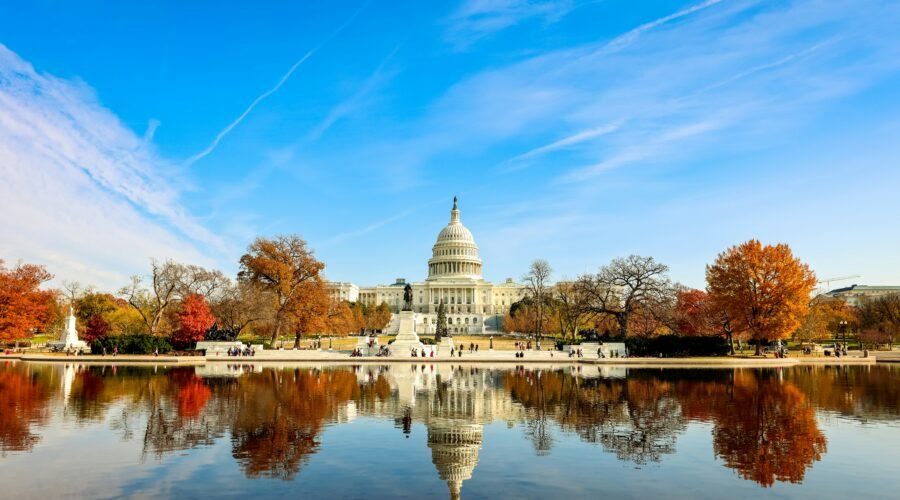
Fall is a standout season to visit Washington, DC because summer humidity fades, school field-trip crowds drop, and oak, maple, and ginkgo trees turn brilliant gold and crimson. From September through November, average highs step down from 81°F to 58°F while rainfall hits its lowest point of the year.
3.1. Early Fall: September
September transitions the capital from summer vacation season into a vibrant cultural calendar. While early September still brings warm afternoons, the second half of the month delivers crisp mornings and significantly shorter lines at major museums.
- The vibe: Cultured and active, with neighborhood street festivals and outdoor jazz performances replacing summer tourist crowds.
- Key events: The DC JazzFest over Labor Day weekend at The Wharf and venues citywide (September 2–6, 2026), the single-day H Street Festival spanning more than 10 blocks of H Street NE (mid-September), and WalkingTown DC (late September), which offers dozens of free guided neighborhood walking tours.
- Crowds: Noticeably lighter at Smithsonian museums right after Labor Day, though convention travel picks up on weekdays.
- Weather: NOAA’s average September high is 81°F (27°C) with an average low of 64°F (18°C) and 5.8 rainy days.
- What to do: Dine outdoors at The Wharf or Navy Yard, stroll historic rowhouse streets in Capitol Hill, and tour the newly revitalized Hirshhorn Sculpture Garden (reopening October 1, 2026).
3.2. Mid-Fall: October
October is arguably the single best month for outdoor sightseeing in Washington, DC. Daytime temperatures sit near 69°F, humidity is low, and October records an average of just 4.9 rainy days—making it the driest month of the year at Reagan National Airport.
- The vibe: Crisp, scenic, and ideal for 15,000-step sightseeing days across parks and historic neighborhoods.
- Key events: Indigenous Peoples’ Day / Columbus Day weekend (second Monday in October), peak autumn foliage beginning in late October, and the Marine Corps Marathon (last Sunday in October; October 25, 2026), which draws 30,000 runners and causes morning road closures around Arlington, Georgetown, and the National Mall.
- Crowds: Moderate during the week, with busier weekends around foliage peak and the marathon.
- Weather: NOAA’s average October high is 69°F (21°C) and the average low is 52°F (11°C).
- What to do: Hike the shaded trails of 1,754-acre Rock Creek Park, photograph the historic National Capitol Columns at the 446-acre U.S. National Arboretum (open daily 8:00 a.m.–5:00 p.m., free admission), and walk the brick sidewalks of Georgetown.
3.3. Late Fall: November
November offers a bridge between late-autumn foliage and the start of Washington’s winter holiday season. Early November often catches the final burst of golden leaves around the Tidal Basin, while mid-to-late November introduces outdoor holiday markets and light displays with fewer visitors than December.
- The vibe: Reflective around Veterans Day and festive after mid-month as holiday markets and ice rinks open.
- Key events: Veterans Day ceremonies at the Vietnam Veterans Memorial, World War II Memorial, and Arlington National Cemetery (November 11), the opening of the free DowntownDC Holiday Market on F Street NW between 7th and 9th Streets (November 13–December 23, 2026), and the start of ZooLights at the National Zoo (select evenings starting November 20, 2026).
- Crowds: Quiet on non-holiday weekdays; busier over Veterans Day and the Wednesday-to-Sunday Thanksgiving travel window.
- Weather: NOAA’s average November high is 58°F (14°C) with an average low of 42°F (6°C) and 5.0 rainy days. Pack a warm coat, scarf, and gloves for evening walks.
- What to do: Browse over 100 artisan stalls at the DowntownDC Holiday Market, tour the National Portrait Gallery and Smithsonian American Art Museum (open until 7:00 p.m. daily), and catch early seasonal theater at Ford’s Theatre.
4. Winter: Quieter Sightseeing and Potential Savings

Winter is the best time to visit Washington, DC if you want uncrowded museum galleries and lower hotel prices. Daytime highs average 45°F to 49°F from December through February, and because the city’s flagship attractions are indoors and free, cold weather rarely disrupts a well-planned itinerary.
4.1. Early Winter: December
December pairs brisk winter weather with signature capital holiday traditions that you cannot see at any other time of year. Visiting during the first two weeks of December lets you enjoy every holiday display with lighter crowds and better hotel rates than Christmas week.
- The vibe: Festive and classic, with grand illuminated evergreens, botanical train displays, and outdoor ice rinks.
- Key events: The National Christmas Tree Lighting on the Ellipse in President’s Park (December 3, 2026; ceremony tickets are distributed via a free Recreation.gov lottery in November, and free public viewing runs daily through January 1 from sunset to 10:00 p.m. Sun–Thu and 11:00 p.m. Fri–Sat), the U.S. Capitol Christmas Tree on the West Front Lawn, Season’s Greenings at the U.S. Botanic Garden (free), ZooLights at the National Zoo (select nights through January 3, 2027; paid timed ticket around $9), and The Washington Ballet’s Georgetown-themed The Nutcracker at the Warner Theatre (November 28–December 27, 2026).
- Crowds: Moderate in early December; busy at museums and holiday displays between December 20 and January 1.
- Weather: NOAA’s average December high is 49°F (9°C) with an average low of 35°F (2°C). Snow in December is uncommon.
- What to do: Skate at the National Gallery of Art Sculpture Garden Ice Rink or The Wharf Ice Rink, tour the decorated halls of George Washington’s Mount Vernon, and see the National Menorah on the Ellipse.
4.2. Mid-Winter: January and February
January and February are Washington’s true off-peak sightseeing months. Aside from holiday weekends and quadrennial Presidential Inaugurations (held January 20 every four years, next in 2029), you can walk straight up to famous exhibits like the Hope Diamond or the Wright Flyer without waiting in deep crowds.
- The vibe: Calm, local, and museum-focused, ideal for travelers who prefer art galleries, historic libraries, and dining deals over outdoor hikes.
- Key events: Martin Luther King, Jr. Day service events and Peace Walk (third Monday in January), Metropolitan Washington Winter Restaurant Week (mid-to-late January, offering multi-course fixed-price lunch, brunch, and dinner menus at hundreds of restaurants), the Washington Auto Show at the Walter E. Washington Convention Center (late January/early February), the Chinatown Lunar New Year Parade (February), and Presidents’ Day weekend programs (third Monday in February).
- Crowds: The lowest of the year on weekdays, with moderate bumps over MLK Jr. Day and Presidents’ Day three-day weekends.
- Weather: NOAA averages show a January high of 45°F (7°C) and low of 30°F (-1°C), and a February high of 48°F (9°C) and low of 32°F (0°C). Washington Reagan National Airport averages 16.6 inches of snow per winter, mostly falling in January and February.
- Costs: Mid-winter weeks outside major conventions regularly offer the year’s most competitive nightly rates at downtown luxury and boutique hotels.
Note: Even on quiet winter weekdays, you cannot walk into every museum without a reservation. Free timed-entry passes are required year-round at the National Air and Space Museum, the National Museum of African American History and Culture, the National Zoo, and the Library of Congress.
5. Shoulder Seasons: When Is the Best Time to Visit Washington, DC Overall?
The shoulder windows of mid-April to May and late September to October represent the best time to visit Washington, DC for most travelers. During these weeks, daytime highs hover between 68°F and 81°F, all outdoor monuments and gardens are comfortable to explore all day, and you avoid both peak cherry blossom pricing and 90°F July heat.
Use this month-by-month comparison of official NOAA 1991–2020 climate normals (Reagan National Airport), crowd levels, and flagship events to compare your travel dates:
| Month / Season | Avg High / Low (NOAA) | Rainy Days (≥0.10″) | Crowds & Hotel Demand | Key Events & Highlights |
|---|---|---|---|---|
| January (Winter) | 45°F / 30°F (7°C / -1°C) | 5.7 days | Low (best hotel value) | MLK Jr. Day, Winter Restaurant Week, Washington Auto Show |
| February (Winter) | 48°F / 32°F (9°C / 0°C) | 5.4 days | Low (except Presidents’ Day) | Black History Month exhibits, Lunar New Year Parade, Presidents’ Day |
| March (Spring) | 57°F / 39°F (14°C / 4°C) | 6.5 days | Moderate early; Peak late month | Cherry Blossom Festival begins (Mar 20), Blossom Kite Festival, peak bloom |
| April (Spring) | 68°F / 48°F (20°C / 9°C) | 6.4 days | Peak early; High mid-to-late | Cherry Blossom Parade & Sakura Matsuri (Apr 10–12), White House Garden Tours |
| May (Spring) | 77°F / 58°F (25°C / 14°C) | 7.3 days | Moderate to High | Passport DC (May 1–31), Embassy Open Houses, Flower Mart, Memorial Day |
| June (Summer) | 85°F / 68°F (29°C / 20°C) | 6.5 days | High (family vacation season) | Capital Pride, Juneteenth, Smithsonian Folklife Festival (late June) |
| July (Summer) | 90°F / 72°F (32°C / 22°C) | 6.7 days | High (Peak on July 4) | Fourth of July Parade, Capitol Concert & Fireworks, Mubadala Citi DC Open |
| August (Summer) | 88°F / 71°F (31°C / 22°C) | 5.6 days | Moderate (softens late month) | Summer Restaurant Week, outdoor concerts, lower late-month hotel rates |
| September (Fall) | 81°F / 64°F (27°C / 18°C) | 5.8 days | Moderate | DC JazzFest (Labor Day weekend), H Street Festival, WalkingTown DC |
| October (Fall) | 69°F / 52°F (21°C / 11°C) | 4.9 days (driest) | Moderate to High | Peak fall foliage (late Oct), Marine Corps Marathon (last Sunday of Oct) |
| November (Fall) | 58°F / 42°F (14°C / 6°C) | 5.0 days | Low to Moderate | Veterans Day (Nov 11), DowntownDC Holiday Market & ZooLights open |
| December (Winter) | 49°F / 35°F (9°C / 2°C) | 6.4 days | Moderate (High Dec 20–31) | National Christmas Tree (lit Dec 3, 2026), Season’s Greenings, ice skating |
5.1. Late Spring: May
May sits in the sweet spot between the April cherry blossom rush and June’s humid school-vacation wave. Parks are in full leaf, daylight stretches past 8:00 p.m., and the free Passport DC embassy open houses on the first two Saturdays of May offer cultural access you cannot get at any other time of year.
- Best dates to target: The first three weeks of May for Embassy Row open houses and garden tours, or Memorial Day weekend if you want to attend patriotic concerts and parades.
5.2. Early Fall: September
Late September delivers warm afternoons, cool evenings, and a sharp drop in family museum lines once schools are back in session. While the first week of September around Labor Day still feels like late summer, temperatures steadily fall into the mid-70s°F by the autumn equinox.
- Best dates to target: The third and fourth weeks of September, which pair comfortable walking weather with neighborhood festivals and easier reservations at top restaurants.
6. Practical Factors for Planning When to Visit Washington, DC
Beyond seasonal weather, your trip experience depends heavily on federal schedules, museum timed-entry rules, and public transit logistics. Knowing which landmarks require advance reservations—and how weekday congressional schedules affect hotel pricing—helps you avoid sold-out attractions and unnecessary costs.
6.1. Special Events and Holidays
Major civic events and federal holidays can close streets around the National Mall and drive up hotel rates in specific weeks. Check these recurring dates before locking in your itinerary:
- National Cherry Blossom Festival (March 20–April 11, 2027): Peak bloom weekends and Parade Saturday bring heavy pedestrian and transit traffic around the Tidal Basin and Constitution Avenue NW.
- Presidential Inauguration (January 20 every four years, next in 2029): Security perimeters close large sections of the National Mall, Pennsylvania Avenue, and Capitol Hill for several days.
- Fourth of July & Major Marches: Independence Day and large rallies on the National Mall bring extra bag screenings and temporary Metrorail station access adjustments near Smithsonian and Federal Triangle stations.
- Marine Corps Marathon (last Sunday in October; October 25, 2026): Morning road closures affect Rosslyn, Georgetown, Rock Creek Parkway, and the National Mall until early afternoon.
6.2. Your Personal Priorities
Match your travel dates to the experience that matters most to your group:
- Best for cherry blossoms: Book the last week of March or first week of April, and include at least three weekdays in your stay.
- Best for all-day walking & photography: Choose May or October for mild temperatures (69°F–77°F highs) and vibrant spring flowers or autumn foliage.
- Best for lowest hotel & flight costs: Pick mid-January through mid-February (excluding MLK Jr. Day and Presidents’ Day weekends) or the second half of August.
- Best for families with school-age kids: Visit in June for 15 hours of daylight and the Smithsonian Folklife Festival, or early December for ZooLights and holiday displays.
6.3. Daylight Hours
Daylight length shapes how many outdoor memorials you can comfortably see before dark:
- Summer (June–August): Around 14 to 15 hours of daylight (sunset between 8:00 p.m. and 8:37 p.m.), giving you ample time for evening monument walks after museums close at 5:30 p.m.
- Spring and Fall (April–May & September–October): Roughly 11 to 14 hours of daylight, ideal for splitting your day evenly between indoor exhibits and outdoor neighborhood walks.
- Winter (November–February): Around 9.5 to 11 hours of daylight (sunset as early as 4:46 p.m. in December). Tour outdoor neighborhoods in the morning, spend 1:00 p.m. to 5:30 p.m. inside museums, and view illuminated memorials after dinner.
6.4. Free Attractions and Museum Reservations
All 17 Smithsonian museums in Washington, DC and the National Zoo offer free admission and open every day of the year except December 25 (most operate from 10:00 a.m. to 5:30 p.m.). However, free admission does not mean walk-up entry everywhere.
According to the Smithsonian Institution, three DC locations require free timed-entry passes:
- National Air and Space Museum (National Mall building): Free timed passes are required for all visitors and release in advance as well as same-day at 8:30 a.m. ET (its sister facility, the Steven F. Udvar-Hazy Center near Dulles Airport in Virginia, does not require timed passes, though parking costs $15 before 4:00 p.m.).
- National Museum of African American History and Culture: Free timed-entry passes open 30 days in advance, with same-day passes released online at 8:15 a.m. ET.
- Smithsonian’s National Zoo: Free entry passes are required for all visitors; vehicle parking requires a separate $30 paid pass.
Three other flagship federal landmarks outside the Smithsonian system also require tickets or reservations:
- Washington Monument: Per the official Washington Monument ticket information, every visitor age 2 and older needs a timed ticket to ride the elevator to the 500-foot observation deck (open 9:00 a.m.–5:00 p.m.). Reserve online at Recreation.gov 30 days in advance at 10:00 a.m. ET (or 24 hours in advance at 10:00 a.m. ET) for a non-refundable $1.00 service fee per ticket. Limited free same-day walk-up tickets are also distributed starting at 8:45 a.m. at the Washington Monument Lodge on 15th Street NW.
- U.S. Capitol: The U.S. Capitol Visitor Center is open Monday through Saturday from 8:30 a.m. to 4:30 p.m. (closed Sundays, Thanksgiving, Christmas, New Year’s Day, and Inauguration Day). Free guided tours of the Crypt, Rotunda, and National Statuary Hall should be booked online in advance or requested through your Member of Congress.
- Library of Congress: Entering the historic Thomas Jefferson Building (open Tuesday–Saturday, 10:00 a.m.–5:00 p.m.) requires a free timed-entry pass from the Library of Congress. Passes release 30 days in advance, with additional same-day tickets posted online at 9:00 a.m. ET.
Pro Tip: Set a calendar reminder for 9:55 a.m. ET exactly 30 days before your trip to book your $1.00 Washington Monument tickets and free Library of Congress passes. Once those timed slots are confirmed, fill in walk-in museums—like the National Museum of Natural History, National Museum of American History, and National Gallery of Art—around them.
6.5. Transportation and Getting Around
Walking the full length of the National Mall from the U.S. Capitol to the Lincoln Memorial covers roughly 2 miles (3.2 km) before you even step inside a museum. Pairing walking with Metrorail and Metrobus saves hours of fatigue.
According to the Washington Metropolitan Area Transit Authority visitor guide, here is how fares and payments work in 2026:
- Tap. Ride. Go. contactless payment: You can tap any contactless credit card, debit card, or mobile wallet (Apple Pay or Google Pay) directly at Metrorail faregates and Metrobus fareboxes. Every rider age 5 and older needs their own card or device; up to two children under age 5 ride free with each paying adult.
- Metrorail and Metrobus fares: Weekday rail fares (opening until 9:30 p.m.) range from $2.25 to $6.75 based on distance. Late-night (after 9:30 p.m.), weekend, and federal holiday rail trips cost $2.25 to a maximum of $2.50 per ride. Standard Metrobus rides cost a flat $2.25.
- Unlimited SmarTrip passes: If you plan to take four or more rides per day, buy a physical SmarTrip card ($2.00 card fee) or add a virtual SmarTrip card to Apple Wallet or Google Wallet to load a 1-Day Unlimited Pass ($13.50) or 3-Day Unlimited Pass ($33.75) for unlimited rail and bus travel (passes cannot be loaded onto contactless credit cards).
6.6. How to Save Money on Your Washington Trip
Because Washington’s top museums and memorials are free, lodging and dining make up the bulk of your travel budget. Use these strategies to keep costs down in any season:
- Target Sunday-to-Wednesday stays in summer and winter: Unlike resort cities, Washington hotels cater heavily to weekday business and government travelers in spring and fall. Weekends in spring and fall or weekdays in late August, January, and February frequently cost 20% to 35% less.
- Stay one or two Metro stops across the Potomac: Hotels near the Rosslyn, Crystal City, and Pentagon City Metro stations in Arlington, Virginia, or Silver Spring and Bethesda in Maryland, sit 10 to 15 minutes by rail from the National Mall at lower nightly rates and lower parking fees ($20–$35 vs. $55–$70+ downtown).
- Fly into DCA to skip long cab rides: Ronald Reagan Washington National Airport (DCA) connects directly to the Metrorail Yellow and Blue lines, taking you into downtown DC in 15 to 20 minutes for $2.25–$3.15 instead of a $45–$80 rideshare from Dulles (IAD) or Baltimore/Washington (BWI).
- Time dining around Restaurant Week: Visiting during Winter Restaurant Week (January) or Summer Restaurant Week (August) lets you book multi-course meals at acclaimed DC dining rooms for fixed prices.
Frequently Asked Questions
1. What is the best time to visit Washington, DC for favorable weather?
Late April, May, and October are the best months to visit Washington, DC for comfortable sightseeing weather. Based on NOAA 1991–2020 climate normals at Reagan National Airport, daytime highs average 68°F in April, 77°F in May, and 69°F in October, while October is also the driest month of the year with an average of just 4.9 rainy days.
2. When is the peak tourist season in Washington, DC?
Peak tourist season in Washington, DC runs from late March through June and peaks again over the Fourth of July holiday week. Cherry blossom season (late March to mid-April) and spring school-trip weeks in April and May bring the highest hotel rates and largest crowds around the Tidal Basin and National Mall.
3. What is the cheapest and least crowded month to visit Washington, DC?
January and February are the least crowded and most affordable months to visit Washington, DC, outside of Martin Luther King, Jr. Day, Presidents’ Day weekend, and quadrennial Inauguration years. Daytime highs average 45°F to 48°F, hotel rates drop significantly, and lines inside the free Smithsonian museums are at their shortest.
4. When should I visit Washington, DC to avoid crowds in warm weather?
The second half of September and the first three weeks of October offer warm-to-mild weather with far smaller crowds than spring or mid-summer. School vacations have ended, Congress is in a regular schedule, and weekday mornings at the Smithsonian museums and Capitol Hill landmarks are much easier to navigate.
5. How can I save on costs when visiting Washington, DC?
Build your itinerary around the 17 free DC Smithsonian museums, the National Mall memorials, and free tours of the U.S. Capitol and Library of Congress. Fly into Reagan National Airport (DCA) for direct $2.25–$3.15 Metro access, use a $13.50 1-Day or $33.75 3-Day Unlimited SmarTrip pass, and compare Metro-accessible hotels in Arlington, Virginia.
6. When do the Washington, DC cherry blossoms usually bloom?
Washington, DC cherry blossoms usually reach peak bloom between the last week of March and the first week of April, though historical dates range from March 15 to April 18. In 2026, peak bloom occurred on March 26, and the upcoming National Cherry Blossom Festival runs from March 20 to April 11, 2027.
7. Which Washington, DC museums require timed-entry passes?
All DC Smithsonian museums are free, but three locations require free timed-entry passes: the National Air and Space Museum on the National Mall, the National Museum of African American History and Culture, and the National Zoo. Outside the Smithsonian, the Library of Congress, U.S. Capitol, and Washington Monument ($1.00 online fee) also require reservations.
8. Can I visit the Washington, DC monuments at night?
Yes, outdoor memorials across the National Mall—including the Lincoln, Jefferson, Martin Luther King, Jr., Roosevelt, WWII, Korean War, and Vietnam Veterans memorials—are open and illuminated 24 hours a day for free. National Park Service rangers are on duty from 9:30 a.m. to 10:00 p.m., while going inside the Washington Monument requires a daytime elevator ticket.
Sources
- National Park Service — Cherry Blossom Bloom Watch: Official 70% Yoshino peak bloom definition, 2026 peak bloom date (March 26), and historical bloom range (March 15–April 18).
- National Cherry Blossom Festival: Official 2026 (March 20–April 12) and 2027 (March 20–April 11) festival, parade, and Sakura Matsuri dates.
- NOAA National Centers for Environmental Information — Washington Reagan National Airport Climate Normals: Monthly average high and low temperatures and precipitation days for station USW00013743 (1991–2020 period).
- Events DC — Passport DC: May 1–31 international cultural festival dates, Around the World Embassy Tour, and EU Open House schedules.
- National Park Service — National Mall Operating Hours: 24-hour outdoor memorial access and daily park ranger duty hours (9:30 a.m.–10:00 p.m.).
- Smithsonian Institution — Entry and Visitor Guidelines: Free admission policy, December 25 closure, and timed-entry pass rules for the National Air and Space Museum, NMAAHC, and National Zoo.
- National Park Service — Washington Monument Fees and Passes: 30-day and 24-hour Recreation.gov reservation windows ($1.00 service fee) and 8:45 a.m. free same-day ticket rules.
- U.S. Capitol Visitor Center — Hours and Info: Operating hours (Monday–Saturday, 8:30 a.m.–4:30 p.m.), holiday closures, and free guided tour reservations.
- Library of Congress — Visiting the Library: Free timed-entry pass requirements for the Thomas Jefferson Building (30-day advance and 9:00 a.m. ET same-day releases).
- WMATA — Visitor Guide: Tap. Ride. Go. contactless payment, Metrorail and Metrobus fare structure, and $13.50 1-Day / $33.75 3-Day Unlimited SmarTrip pass prices.